The Stall Isn't a Problem: What Your Short Ribs Are Doing at 150°F (and Why You Should Let Them)
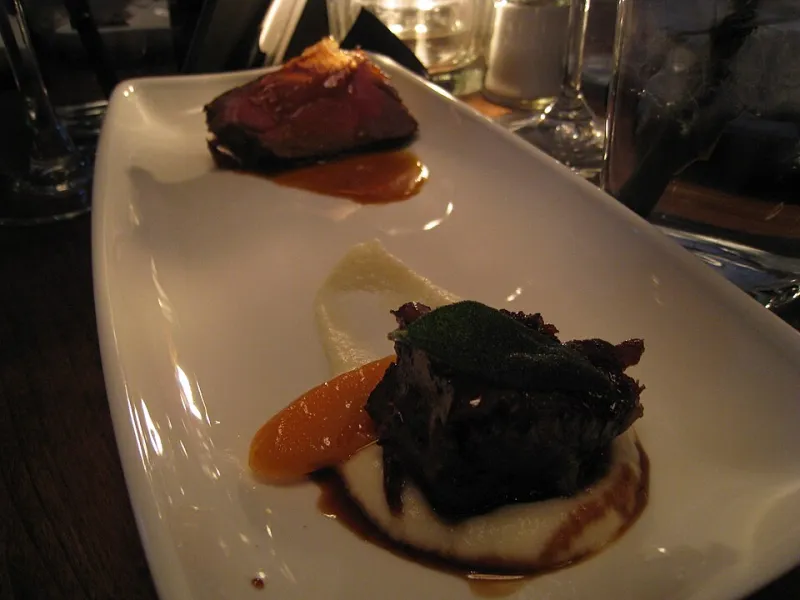
Photo: Mack Male from Edmonton, AB, Canada, CC BY-SA 2.0, via Wikimedia Commons
There's a moment in every braise — usually around hour three — when a home cook checks the internal temperature of their short ribs, sees 150°F, and then checks again forty minutes later to find... 150°F. Not 151. Not 152. The number just sits there like a bad stock portfolio.
The instinct is to panic. The second instinct is to crank the oven. Both are wrong, and understanding why is the difference between fork-tender braised beef and a $30 plate of regret.
What's Actually Happening in There
Braising is a conversion project. You're not really "cooking" the meat so much as convincing tough collagen — the connective tissue that makes chuck, brisket, pork shoulder, and short ribs cheap — to transform into gelatin. That transformation doesn't happen at a nice, even pace.
Collagen starts breaking down around 160°F, but the real magic happens slowly, over hours, in the 160–180°F range. And here's the cruel part: while that's happening, the meat is undergoing evaporative cooling. Moisture migrating to the surface of the meat evaporates and pulls heat away, exactly like sweat on a runner. Your oven is pumping in energy, but the meat is spending every degree it gains on converting collagen and cooling itself through evaporation.
The result is the stall: a plateau where internal temperature refuses to budge, sometimes for two or three hours. Pitmasters talk about this constantly with brisket, but it shows up in any braise with enough connective tissue. It's not a malfunction. It's the work being done.
Why Cranking the Heat Backfires
The panicked fix — bump the oven to 400°F — technically works. The temperature will move. But you've traded tenderness for speed, and you lose on both ends:
The collagen doesn't get enough time. Gelatin formation is time-and-temperature dependent. Rush it and you get meat that's technically done but still chewy in that specific, fibrous way that no amount of resting fixes.
The protein squeeze gets aggressive. Higher heat means faster muscle fiber contraction, which means more moisture gets wrung out of the meat and into your braising liquid. The fibers tighten into a hard, dry grain.
You end up with the worst of both worlds: tough texture outside, and a flavorful liquid doing all the heavy lifting because the meat checked out.
A Rough Timeline So You Know What's Normal
Every cut and every pot is different, but here's a general map for a 3-pound batch of beef short ribs braising at 300–325°F:
- Hour 0–1: Internal temp climbs quickly to 130–150°F. Nothing interesting yet.
- Hour 1.5–3.5: The stall. Temp hovers between 145–155°F. Collagen is converting. This is where amateurs quit and pros read a book.
- Hour 3.5–4.5: The breakthrough. Temp starts climbing again, slowly, toward 195–205°F. The meat goes from resistant to probe-tender — a skewer should slide in with no more effort than poking warm butter.
- Past that point: You're in diminishing-returns territory. A little longer deepens the texture; a lot longer turns everything to mush.
For pork shoulder, expect a longer, deeper stall — sometimes four hours — because there's simply more collagen to convert.
When It's Actually Something You Did Wrong
Not every plateau is the noble stall. Here's how to tell the difference:
Your oven runs cold. If after four hours the liquid is barely simmering and the temp hasn't moved at all, verify with an oven thermometer. (We've covered this before — your oven lies.) A braise needs gentle bubbles, not a warm bath.
Not enough liquid coverage or a lid problem. If the stall stretches past four hours with no progress, check that your lid is sealing. Excessive evaporation can cool the meat faster than the oven can heat it.
Meat straight from the fridge. A 38°F slab of chuck adds an hour to everything. Pull it out 45 minutes before it hits the pot.
The temp is stuck below 140°F entirely. That's not a stall; that's a food safety concern. Above 140°F you're in the safe slow-cook zone. Below it for extended periods, you're incubating, not braising. Fix the heat source immediately.
The Home Cook's Real Advantage
Here's the part restaurant cooks know and home cooks forget: a stalled braise is nearly impossible to ruin. Unlike a steak, where thirty seconds separates medium-rare from medium, a braise in the stall zone has hours of forgiveness built in. The oven is gentle. The liquid is shielding the meat. Time is on your side — literally the entire point of the technique.
So the next time your probe reads 150°F for the third consecutive hour, resist the dial. Pour yourself something nice, poke the meat with a skewer every forty-five minutes, and wait for the breakthrough. It always comes. The stall isn't your braise failing — it's your braise working, one degree of gelatin at a time.